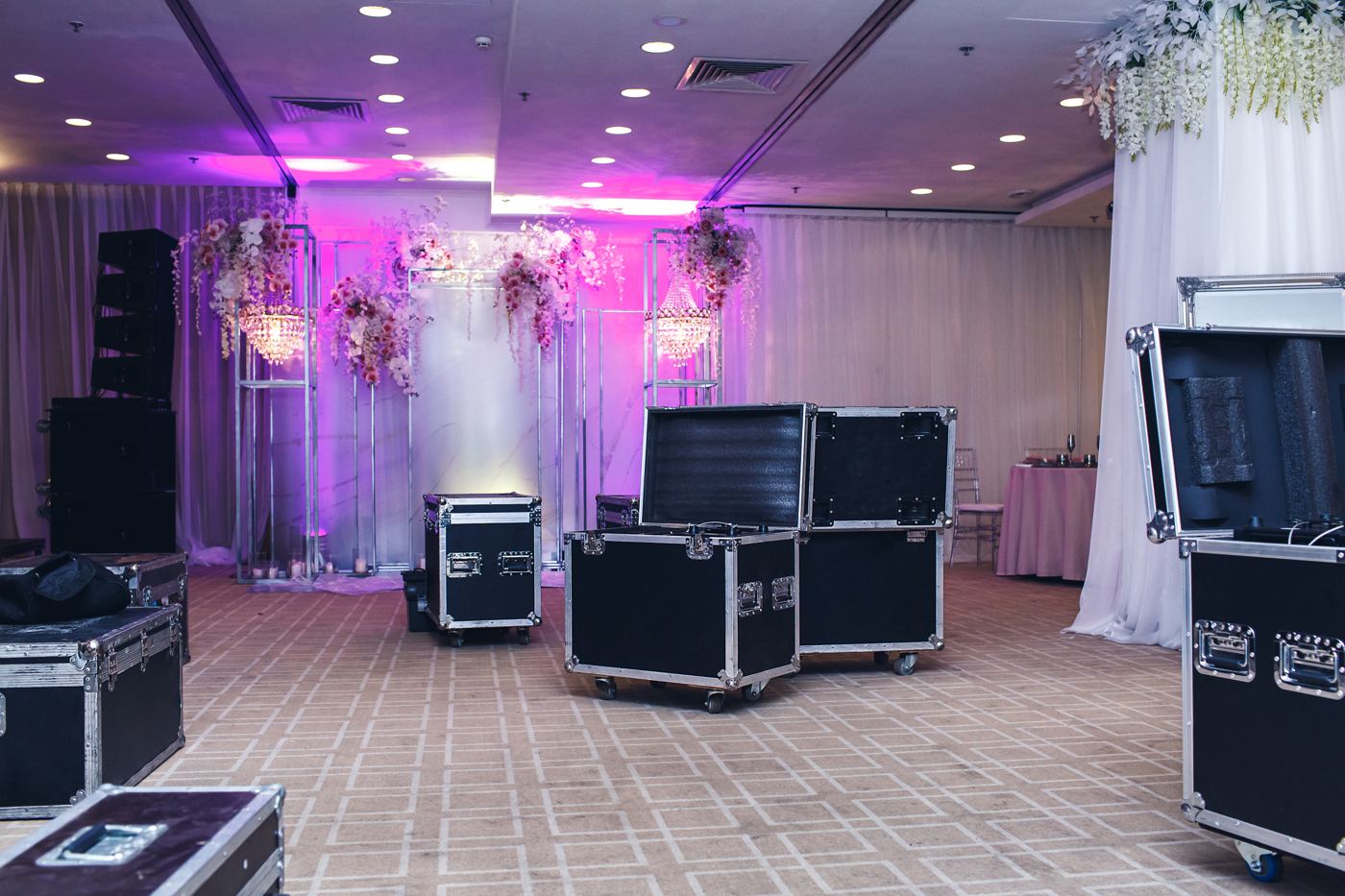
Atlanta Music Pros provides corporate stage lighting throughout Metro Atlanta for conferences, general sessions, annual meetings, awards programs, product launches and corporate galas. Corporate lighting can include presenter key lighting, stage wash, camera-ready levels for IMAG and recording, podium lighting, scenic and set lighting, branded uplighting, general room lighting and lighting cues for awards and reveal moments.
Corporate lighting has a different job from party lighting. A dance floor wants energy, movement and color. A general session wants a presenter whose face reads clearly from the back row and on a twelve-foot screen, a stage with no dark patches to walk into, and a room that feels considered rather than fluorescent.
We do both — the entertainment lighting on our event lighting page covers the social half of the evening. This page is about the functional part: making people on stage look like they are worth listening to.
Both are legitimate and many events need both at different times of the evening. They are designed to entirely different criteria.
| Corporate stage lighting | Dance floor and party lighting | |
|---|---|---|
| Purpose | Make presenters clearly visible and the stage look intentional | Create energy, movement and atmosphere |
| Direction | Front key light on faces, even wash across the stage | Overhead and from behind, effects across the floor |
| Color | Neutral on faces; color reserved for scenic and room elements | Saturated color, changing throughout the night |
| Movement | Static states with cued changes between segments | Continuous movement and beat-driven effects |
| Camera consideration | Central — levels set for IMAG and recording | Rarely a factor |
| Failure mode | A presenter in shadow, or eyes lost under a downlight | A floor that feels flat |
The one that matters most.
No dark holes to walk into.
Notes people can actually read.
Lighting for the screen, not only the room.
Making the stage look designed.
Room color.
So attendees can function.
Lighting that follows the show.
Almost every corporate stage lighting problem is the same problem, and it is worth understanding because it is cheap to fix.
Ballroom house lighting is designed to illuminate tables, and it comes straight down from the ceiling. On a face, downlight puts the brow in the way of the eyes, producing dark eye sockets, a shadow under the nose, and an overall effect of somebody standing in a cave. In the room it is merely unflattering. Magnified onto a large screen, it looks unmistakably amateur.
A pair of fixtures throwing light at the presenter area from the front changes the result completely: eyes visible, expression readable, a face that looks lit rather than overhead-lit. This is consistently the highest-value, lowest-cost addition to a general session, and it improves IMAG, the recording and any stream at the same time.
A large LED wall or a bright projection screen behind a presenter raises the background level dramatically. Without front light to compete, the camera sees a bright wall and a silhouette in front of it. Lighting and display design therefore have to be decided together, not quoted as separate line items by separate companies.
Lighting aimed carelessly puts a fixture directly in the presenter’s eyeline, which means they cannot see the audience, the confidence monitor or the stairs. Focusing the rig with somebody standing on the stage, rather than from the floor, takes ten minutes and prevents that.
An illustrative lighting plan for a day session that becomes an awards dinner in the same ballroom. An example of how the elements combine, not a past project or a price.
Where the evening turns into a party, the dance floor plan is a separate design that sits on top of this one — see event lighting and corporate DJ services.
Lighting design is constrained by what the venue permits: whether fixtures can be hung and who is allowed to hang them, available power circuits, whether house lighting can be dimmed or zoned independently, and whether the ballroom’s installed lighting can be controlled at all. Being able to dim the house lights over the stage area is sometimes the difference between a good look and an impossible one.
Venue policies, outside-vendor requirements, power, internet, loading access and production restrictions should be confirmed with the venue during pre-production. Many hotels, arenas and convention facilities maintain in-house AV departments, exclusive service providers, union labor rules, rigging approvals and outside-vendor fees, and those terms decide what any outside company can do in the room.
Atlanta Music Pros is an Atlanta-based company covering Metro Atlanta and North Georgia. We travel to the venue rather than operating suburban offices.
Yes, and it is one of the highest-value additions to a general session. Presenters need front key light so faces read from the back of the room, an even stage wash with no dark patches to walk into, and enough light on the podium to read notes. Hotel ballroom house lighting comes straight down from the ceiling, which shadows the eyes — barely noticeable in person, and clearly bad once magnified onto a screen.
Purpose and direction. Corporate lighting exists to make presenters visible and the stage look intentional: front light on faces, neutral color on skin, static states that change on cue. Party lighting exists to create energy: saturated color, movement, effects over a dance floor. Many events need both at different points in the evening, and they are designed as two separate plans that coexist.
Because a camera has far less latitude than a human eye. A presenter who looks acceptable in the room can look genuinely poor on a screen or in a recording, particularly under overhead-only lighting. Cameras also need more light overall and from the front. If you are adding IMAG, recording or streaming, front key light stops being a nice touch and becomes part of making the video usable.
It makes it harder. A bright wall behind a presenter raises the background level dramatically, and without front light to compete the camera renders the speaker as a silhouette against it. Lighting and display have to be designed together, with wall brightness and stage light levels balanced against each other. This is a common problem when the screen and the lighting are quoted by different companies.
Generally yes, where brand guidelines or reference values are supplied. Color fixtures can be set close to a specified brand color, and we would rather check it against your reference in advance than guess on the day. Perimeter uplighting is one of the most cost-effective ways to transform a neutral ballroom, and colors can change between the session and the evening program.
Yes. Lighting states for walk-in, presentation, video playback, each award and the transition to dinner can all be run from a cue sheet alongside audio and video. Awards programs benefit particularly, because a lighting change is what signals to a room that a moment is happening. It requires a finalized running order in advance and a rehearsal, since award timing is where errors are most visible.
Less than a concert and more than most planners budget for. The functional minimum for a general session with cameras is front key light on the presenter area plus an even stage wash. Beyond that, scenic lighting, branded uplighting and cued states are design choices rather than requirements. We will tell you which parts are doing real work and which are aesthetic, so you can spend accordingly.
Whether fixtures may be hung and by whom, available power circuits, and whether house lighting can be dimmed or zoned independently. That last one matters a lot: being able to bring down the house lights over the stage while keeping the room usable is sometimes the difference between a good look and an impossible one. All of it should be confirmed with the venue during pre-production.
Tell us the room, the stage size, whether there are cameras, and whether the event turns into an evening program. Lighting for a camera is a different plan from lighting for a room, and it is worth knowing which you need.