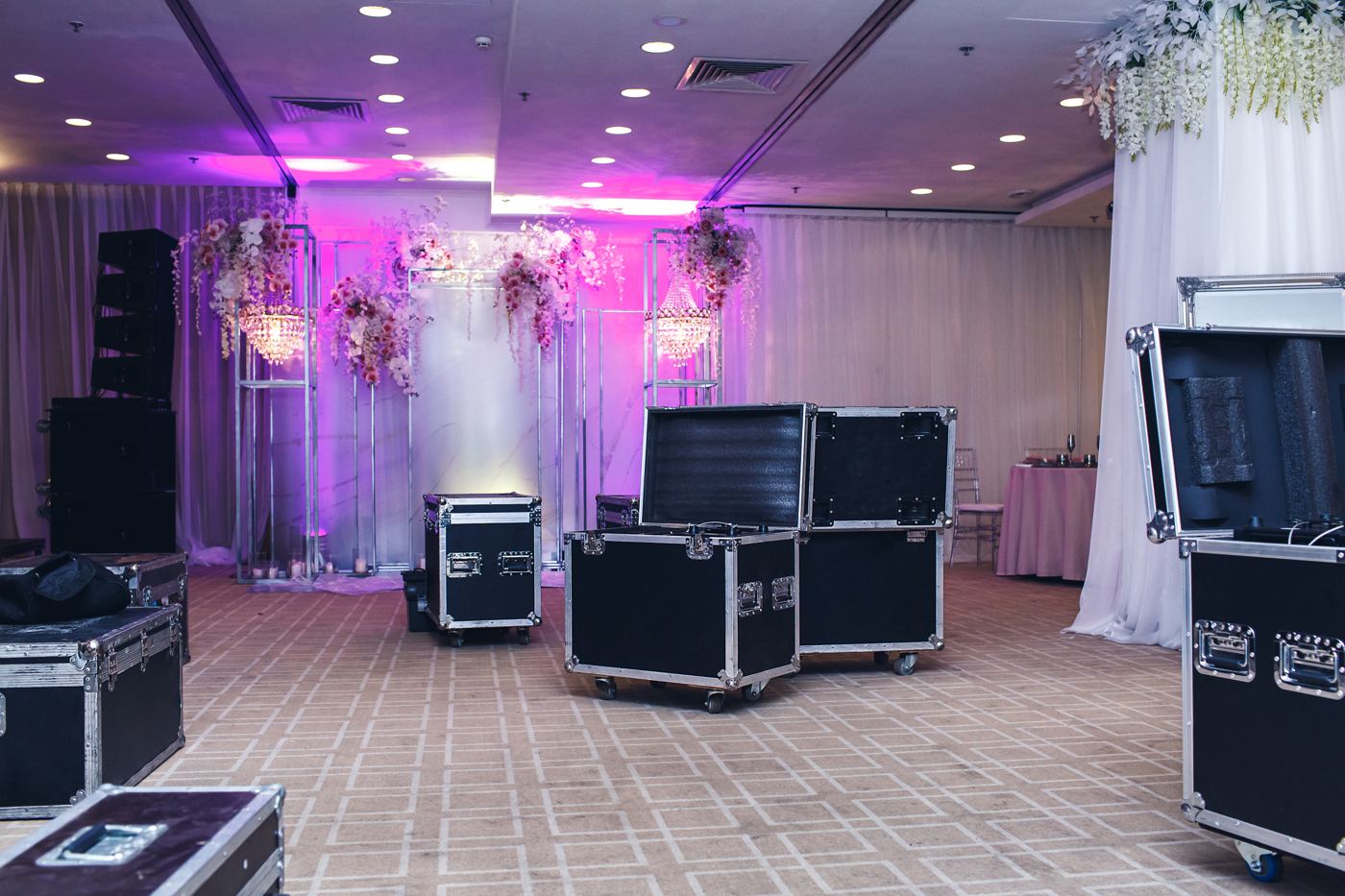
Atlanta Music Pros provides general session AV and production throughout Metro Atlanta for conferences, annual meetings, sales kickoffs, association plenaries and corporate award programs. A general session package can include ballroom PA and program audio, wireless presenter and podium microphones, presentation playback and management, confidence monitors where available, projection or LED displays, IMAG camera work, walk-on music and video playback, stage and presenter lighting, staging, show calling, technical operators and rehearsals.
The general session is the room your event gets judged on. It is where the CEO speaks, where the keynote lands or does not, and where four hundred people find out whether this is a well-run conference. It also carries the largest share of the AV budget, for the straightforward reason that it needs the big PA, the big screen and the crew.
Producing one well is mostly about removing the small failures that accumulate into a rough-feeling show: the podium mic that is quieter than the handheld, the video that plays silently, the presenter squinting back at their own slides, the awkward gap while someone finds the next deck.
A general session package is assembled from these elements. Which ones apply depends on the room, the guest count and how scripted the program is.
Speech first, music second.
Assigned per presenter, not handed round.
Sized so the back row can read a slide.
Run from one place by one person.
So the back of the room sees a face.
Different from dance-floor lighting.
The layout everything else depends on.
People, not equipment.
This is an illustrative package for a common Atlanta scenario: a morning general session with three presenters, a keynote, a video and an awards segment, in a hotel ballroom. It is an example of how a package is assembled — not a description of a past project, and not a price.
Add breakout rooms, a livestream, multi-camera coverage or an evening gala in the same room and the package changes materially. We would rather scope against your run of show than sell a fixed tier.
System built to the room plan: PA positioned and tuned, screen or LED aligned, staging set, lighting focused, cable runs protected.
Every microphone swept, assigned and level-checked. Playback tested. Slide source confirmed at the right resolution and aspect ratio. Recording and stream paths verified.
Presenters walk the stage, wear their microphone, hear themselves in the room, advance their own slides and find the confidence monitor. This is where most show-day problems are caught.
Walk-on music, lighting states, video playback, graphics and award cues written into a single running order the whole crew works from.
Walk-in music at a level people can talk over, holding slide on screen, room lighting set, crew on the desks.
Levels ridden live, slides advanced on cue, IMAG switched against content, playback fired on the caller’s cue, lighting states changed between segments.
Presenter changeovers handled so there is no dead air: music up, mic swapped, next deck already loaded.
Room cleared inside the venue’s window, recordings handed over as agreed in the scope.
General session quality is cumulative. None of these individually is dramatic; together they are the difference between a session that feels produced and one that feels improvised.
If the bottom of the screen sits at seated head height, half your audience cannot read the lower third of every slide. Screen height and stage height get decided together, against the room’s seating plan and ceiling.
Passing a single lavalier between speakers costs thirty seconds of dead air and a re-gain each time. Assigning a microphone per presenter, and mixing them properly, removes an entire category of awkwardness.
A video that arrives 10 dB louder than the presenter who introduced it makes an audience flinch. Playback levels get set in the technical check, not discovered in front of the room.
On a scripted program, a show caller running the cue sheet keeps audio, video, lighting and the stage in agreement about what happens next. It is the cheapest production value available. Where the session turns into an evening program, our awards gala production and corporate DJ teams pick it up from there.
Ballroom behavior varies enormously: ceiling height, glass walls, air handling noise, existing house speakers, rigging points and available power all change what the right system is. A room walk-through, or at minimum a floor plan and a conversation with the venue, comes before the plan.
Venue policies, outside-vendor requirements, power, internet, loading access and production restrictions should be confirmed with the venue during pre-production. Many hotels, arenas and convention facilities maintain in-house AV departments, exclusive service providers, union labor rules, rigging approvals and outside-vendor fees, and those terms decide what any outside company can do in the room.
Atlanta Music Pros is an Atlanta-based company covering Metro Atlanta and North Georgia. We travel to the venue rather than operating suburban offices.
The general session is the part of a conference or corporate meeting where everybody is in one room together — the opening, the keynote, the CEO address, the awards. Breakouts are the concurrent smaller sessions that run around it. The general session usually carries most of the AV budget because it needs the largest PA, the largest screen, IMAG and the biggest share of the crew.
Typically ballroom PA with even coverage and a proper program mix, wireless microphones assigned per presenter plus a podium mic and handhelds for Q&A or awards, a large screen or LED display, presentation management run from a show machine, an IMAG camera so the back of the room can see the presenter, stage and presenter lighting, staging, playback for walk-in and video, and technical operators. Show calling is added for scripted programs.
Yes, and it is a different job from party lighting. Presenters need front key light so faces read from the back of the room and on camera, a stage wash covering the whole performance area, and enough light on the podium to read notes. Overhead-only lighting leaves speakers in shadow, which looks worse on an IMAG screen than it does in person. Branded uplighting and room color can be added on top of the functional lighting.
Where the room, budget and stage layout allow, yes. A confidence monitor is a screen facing the stage showing the presenter’s current slide and notes, so they are not turning round to read the screen behind them. It makes a measurable difference to how composed a presenter looks on camera. Availability gets confirmed as part of the scope rather than assumed.
It depends on the scale and on the venue’s access. A single-screen ballroom session with PA, mics, projection and lighting is commonly an evening-before or early-morning load-in. Add LED, multi-camera, significant staging or a rehearsal day and it becomes a longer build. Load-in time is also a cost factor, because it is driven by dock scheduling, freight elevator availability and venue labor rules as much as by the equipment.
For anything scripted, strongly recommended. A rehearsal is where presenters wear their microphone, hear themselves in the room, advance their own slides and find the confidence monitor, and where the crew runs walk-on music, video playback, lighting states and award cues against the cue sheet. It is where problems are found cheaply. A straightforward single-presenter session can usually manage with a technical check and a walk-through.
Yes. Walk-on and walk-off music per award, category stings, a bed underneath the nominee read, applause coverage and a video playback cue can all be programmed and fired against a cue sheet by an operator or DJ. The practical requirement is a finalized running order in advance and a rehearsal, because award segments are where timing errors are most visible. Our awards gala production page covers the full evening.
The variables are room size and guest count, whether the display is projection or LED, the number of wireless microphone channels, camera count, whether the session is recorded or streamed, the lighting plan, crew, load-in and strike hours, and whether a rehearsal day is required. Those move the number far more than headline attendance does. The corporate AV pricing page explains each factor so you can see what your own scope is driving.
Send the room, the guest count and your run of show. General session quotes are built from the program — presenter count, awards segments, video playback and whether the session is recorded or streamed — so the agenda is the most useful thing you can give us.