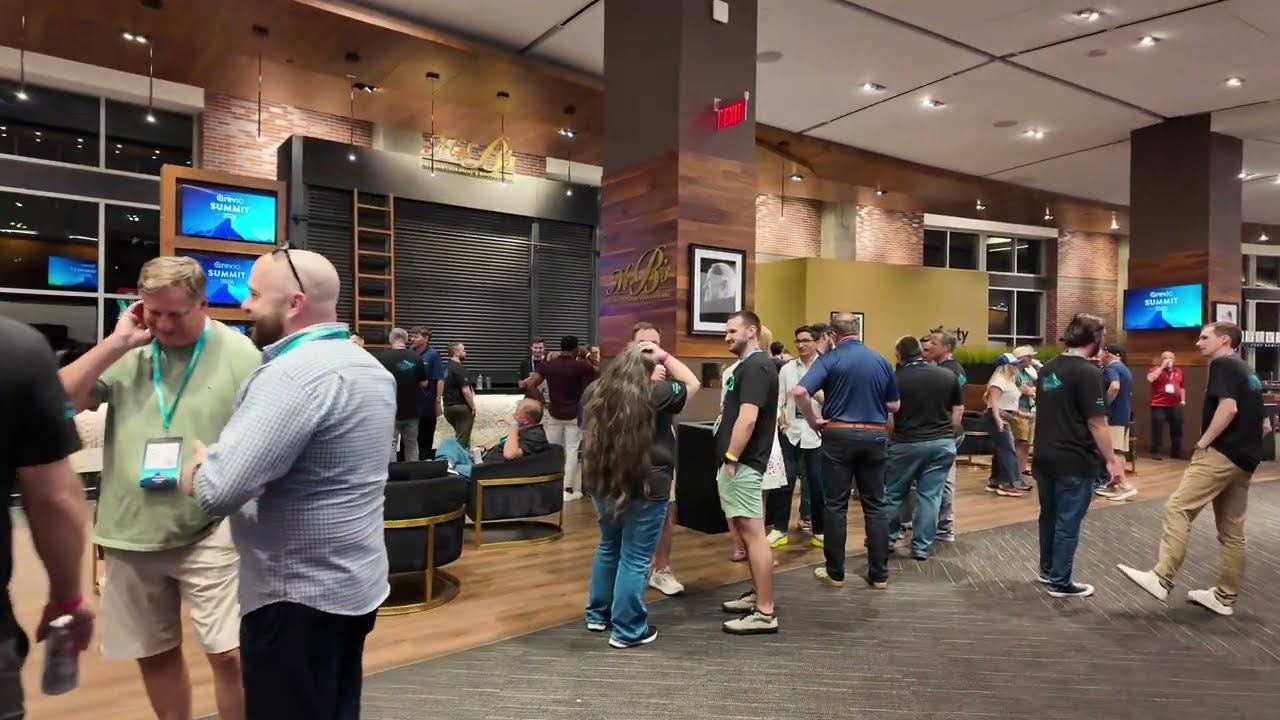
Atlanta Music Pros provides hybrid event production throughout Metro Atlanta for companies running one event for both a room full of people and an audience joining remotely. Hybrid production can include in-room audio and presentation systems, operated cameras and live switching, integration with Zoom or Microsoft Teams, remote presenters routed into the room, presentation sharing to both audiences, moderated Q&A across room and remote participants, recording and live streaming.
A hybrid event is two shows sharing one stage. The room needs a PA, screens and a presenter who can work an audience. The remote audience needs a readable picture, desk-quality audio, and the sense that they are part of the event rather than watching a security camera.
The design decisions that follow from that are specific: where the cameras sit, whether remote questions are read aloud or heard live, how a remote speaker is made audible in the room, and who is responsible for the chat. Get those wrong and one of the two audiences has a bad time.
Most hybrid problems come from designing for the room and treating the remote audience as an afterthought, or the reverse. Both columns have to be satisfied by the same stage.
| The audience in the room | The audience at home | |
|---|---|---|
| Audio | Even PA coverage, intelligible speech, playback at a sensible level | Program mix from the desk, balanced for headphones, Q&A audible |
| Picture | Large screen or LED they can read from the back row | Slides as a clean digital source, presenter framed close enough to read |
| Presence of remote people | Remote speakers audible through the PA and visible on the screen | A sense that the room can hear them, not just tolerate them |
| Q&A | A handheld microphone that reaches them | Questions read or routed so they are heard, and a path to ask their own |
| Pacing | Room energy, applause, live reaction | Fewer dead gaps, holding slates during breaks, clear segment starts |
| The host | Someone working the room | Someone who occasionally speaks to camera on purpose |
PA sized to the room, wireless microphones for presenters and Q&A, projection or LED for slides, and stage lighting so presenters read on camera. See wireless microphone options and corporate stage lighting.
One to four angles, switched live between presenter, wide, panel and slides so the remote feed has variety and focus. See multi-camera live production.
The room joins the meeting as a proper participant: program video in, program audio in, and the meeting’s audio out through the PA. Configuration is verified against your license and tenant before the date.
A speaker joining from elsewhere gets routed to the screens and the PA, with a return feed so they can hear the room and time their delivery. Tested in a rehearsal, not discovered live.
Slides go to the in-room screen and the remote feed from the same source, so both audiences see the same thing at the same moment and nobody is describing a slide the other half cannot see.
A defined process: who watches the chat or Q&A panel, who reads remote questions aloud, and how in-room questions reach a microphone. Ambiguity here is what makes hybrid Q&A awkward.
Program feed recorded locally, independent of the platform recording, so you have a clean archive whatever the network does.
Where the remote audience does not need to speak, a one-way monitored stream is simpler and more robust. See corporate event live streaming.
An illustrative configuration showing how a hybrid all-hands is usually assembled. Clearly an example rather than a past project or a price.
If the remote audience only needs to watch, a one-way stream is cheaper, simpler and more reliable. Hybrid is worth the extra complexity specifically when remote people need to participate.
Hybrid events lean harder on venue infrastructure than any other AV service, because a dropped network connection is visible to your remote audience immediately. A wired connection with confirmed upload bandwidth, tested from the actual room, is the baseline requirement.
Venue policies, outside-vendor requirements, power, internet, loading access and production restrictions should be confirmed with the venue during pre-production. Many hotels, arenas and convention facilities maintain in-house AV departments, exclusive service providers, union labor rules, rigging approvals and outside-vendor fees, and those terms decide what any outside company can do in the room.
Atlanta Music Pros is an Atlanta-based company covering Metro Atlanta and North Georgia. We travel to the venue rather than operating suburban offices.
A hybrid event has a live audience in the room and a remote audience participating at the same time, usually with some presenters joining from elsewhere. The distinction from a livestream is participation: stream viewers watch, while hybrid attendees can ask questions, be seen and sometimes speak. That difference drives real production decisions, including return feeds for remote presenters, mix-minus audio and a defined Q&A process.
Yes, that is the most common hybrid request in corporate work. The room joins the meeting as a participant: the switched program video and desk audio mix go in, and the meeting’s audio comes out through the room PA so the live audience hears remote speakers properly. Configuration depends on your license and tenant settings, so we confirm the specific setup with your IT or events team and test it before the event rather than assuming it.
Through whichever channel you want to own — platform chat, a Q&A panel, or an event app — with a named person responsible for monitoring it and feeding questions to the host. The part worth deciding in advance is whether remote questions are read aloud by the moderator or the remote attendee is unmuted to ask live. Both work; the failure mode is not deciding, which leaves the host guessing on stage.
Because they are receiving a feed that includes their own voice, delayed. The fix is a mix-minus: an audio feed containing everything except that participant’s own microphone. It is a standard part of hybrid audio design and one of the clearest signs of whether a hybrid event was produced or improvised. We set it up and test it in rehearsal.
Yes. Sending the camera feed to the in-room screens is called IMAG, and it is what lets a large room see the presenter’s face rather than a distant figure on a stage. In a hybrid event the same switched feed can serve the room screens, the remote audience and the recording, which is one of the practical arguments for producing both audiences from one system. Our IMAG page explains it in more detail.
Usually, yes. Hybrid adds two-way audio routing, return feeds for remote presenters, platform operation, Q&A moderation support and more rehearsal time than a one-way stream needs. If your remote audience genuinely only needs to watch, a monitored stream delivers a better experience for less money. We will say so if that is the case rather than selling complexity you do not need.
A wired connection with a known, sustained upload rate, tested from the room you are actually using. Guest wi-fi is shared with every attendee in the building and is not suitable. At most Atlanta convention facilities and conference hotels a dedicated hard line is a paid item ordered through the venue, so it should be raised early along with any power and internet charges. Where the stakes justify it, we plan a backup path.
Often, yes, and corporate offices can be easier than hotels because you control the network and access. The things to check are ceiling height and sightlines in the room you intend to use, whether the space is acoustically workable for speech, available power circuits, and whether your IT team can provide a wired connection with sufficient upload bandwidth. We will look at the room before committing to a plan.
Tell us how many people are in the room, how many are joining remotely, whether remote attendees need to speak, and which platform you are using. Those four answers determine most of a hybrid scope.